Thailand Welcome Guide for Interns

Quick answer: This guide covers what you need to know before and after you land in Thailand: workplace tips, the Thai Baht, SIM cards, getting around Bangkok, food, health and culture. Exchange money in the city rather than at the airport, register a SIM with your passport at a carrier shop, and show respect for the monarchy and for local customs.
Useful Tips For Your Internship
Welcome to Thailand!
Your internship experience is one of the most important pieces of the foundation you are laying down for a successful career.
Since the professional world can be very different from university life, it's important that you have an understanding of some of the differences.
Use these tips to help you make the most of your internship
- Clarify expectations about the internship, both the employers and yours. It's a good idea to agree upon your job responsibilities in writing.
- Take advantage of the transition time at the beginning of your internship and ask a lot of questions.
- Meet regularly with your supervisor to ensure that both of your expectations are being met.
- First impressions are very important, as is maintaining good ones. It's important for you to dress, speak, write, and generally behave like a professional.
- Be observant and ask questions about appropriate behavior at the work place. Different organizations have different expectations regarding employee behavior.
- Focus on your communication skills, both written and verbal. Proofread your written work carefully. When communicating with your co-workers choose a respectful, tactful, and professional language at all times.
- Be punctual and show up to work on time. If you're going to be late or sick, be sure to call your supervisor to inform them. Choose your sick days with care and try not to miss too many days at work.
- Establish good relationships with your co-workers. Be friendly, polite, helpful, and sensitive. Also be careful about bringing personal business to work.
- Be easy to work with. Accept assignments without complaint, ask for more work when assignments are completed, and turn out good quality work.
- When you complete your internship, be sure to ask your supervisor for a letter of recommendation and keep in touch so that you can call upon him/her later when you are in need of a reference.
Here's a good read on internships and your future career.
Emergency Information
In case of any emergencies, here are important phone numbers to have on hand:
- Tourist Police: 1155 (the easiest line for visitors)
- Police and general emergencies: 191
- Ambulance and emergency medical services: 1669
- Fire and rescue: 199
Save these in your phone before you arrive.
Money Exchange
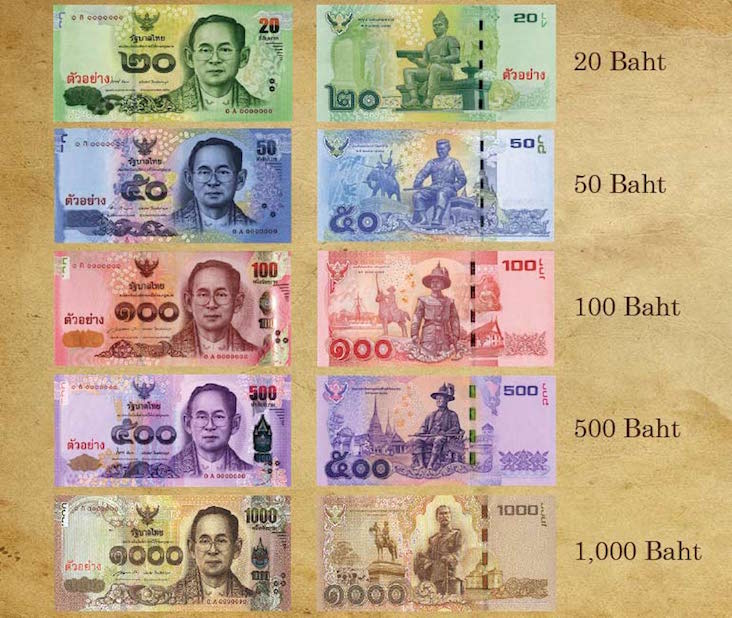
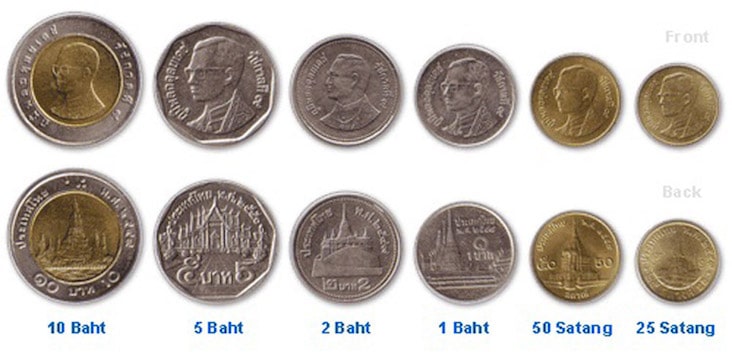
The currency used in Thailand is the Thai Baht.
The banknotes in use are THB 1000, 500, 100, 50, and 20. The coins in use are THB 10, 5, 2, 1, 0.5, and 0.25.
Exchange rates change daily, so check the current rate before you travel. As a rough guide, 1000 Thai Baht has been worth somewhere around $30, so use a currency converter for an up-to-date figure.
Where should you exchange money in Thailand?
When you come to Thailand we recommend you to exchange your local currency to Thai Baht within the city, rather than at the airport.
The currency exchange companies in the city give a much better exchange rate than the ones at the airport.
Exchange shops that are popular for good rates include Vasu Exchange, Super Rich, and SIA Money Exchange.
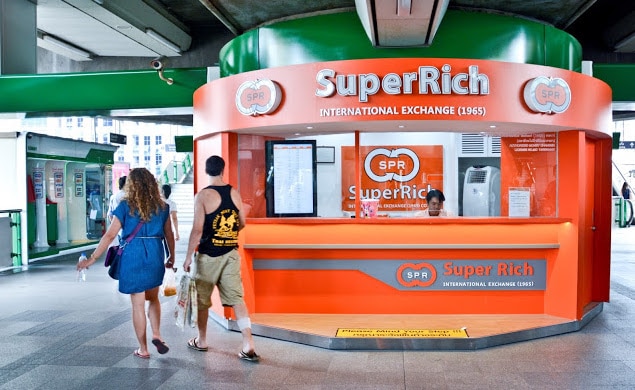
You will also find exchange booths at many BTS and MRT stations and in major shopping malls. Rates vary, so compare a few before you change a large amount.
Which SIM card should you get in Thailand?
Thailand has two main mobile networks: AIS and True. True also runs the dtac brand, after the two companies merged in 2023.
Bring your passport. Under rules in force since May 2026, foreigners must register a SIM in person at a carrier shop or authorized dealer, and can have up to three SIMs per network. You can find carrier shops in most major shopping malls.
For more tips on settling in, read our guide to doing an internship in Bangkok.
Useful Thai Phrases
The Thai language can be quite difficult for new foreigners. Especially since the Thai language has its own unique alphabet.
It's very beneficial to know some useful phrases during your stay in Thailand.
Here are some basics to get started, written the way they sound.
Also very important to know is that "Ka" and "Krub" are polite words to say at the end of a sentence or expression.
Ka is used for females and Krub is used for males.
| Phrase | Thai | Say it like | When to use it |
|---|---|---|---|
| Hello / goodbye | สวัสดี | sawasdee krub / ka | Greeting anyone, any time of day |
| Thank you | ขอบคุณ | khop khun krub / ka | After any help or service |
| Sorry / excuse me | ขอโทษ | khor thot krub / ka | Apologizing or getting someone's attention |
| No problem / never mind | ไม่เป็นไร | mai pen rai | Replying to thanks or an apology |
| How much? | เท่าไหร่ | tao rai | Asking a price at a market or stall |
| Not spicy, please | ไม่เผ็ด | mai phet | Ordering food |
| Delicious | อร่อย | a-roi | Complimenting food |
| Where is the toilet? | ห้องน้ำอยู่ที่ไหน | hong nam yoo tee nai | Asking for the bathroom |
| I don't understand | ไม่เข้าใจ | mai khao jai | When you get lost in the conversation |
Places To Visit
The Grand Palace
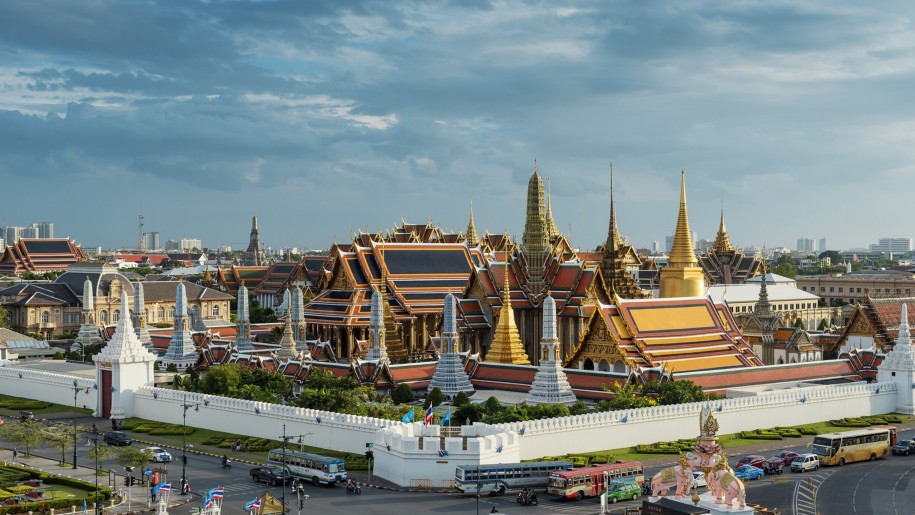
The Grand Palace was built in 1782 and is home of the Thai Kings and Royal Court. Its beautiful architecture attracts many tourists.
When you visit the Grand Palace make sure that you dress properly.
Men must wear long pants and shirts with sleeves. Women must be dressed similarly, with no see-through shirts and no bare shoulders shown.
If your clothing isn't appropriate, there is a booth near the entrance which provides you with proper clothing, for which you have to pay a deposit.
Wat Arun
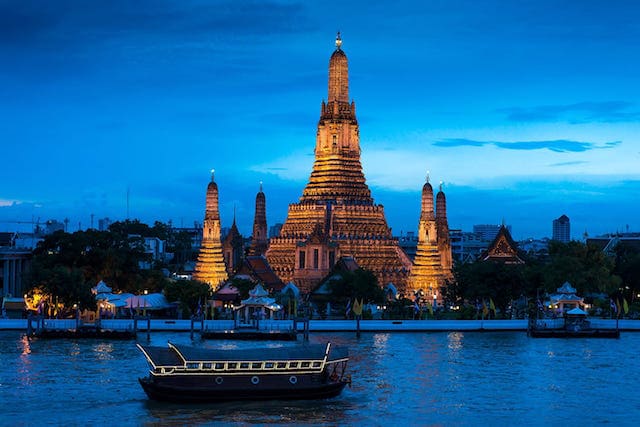
Wat Arun's tall central tower (prang) was built in the first half of the 19th century in the Khmer style, though a temple stood on the site long before.
The Temple of Dawn is linked to King Taksin, who set up his new capital at Thonburi, right next to the temple, after Ayutthaya fell in 1767.
The quietest time to visit is early in the morning before the crowds arrive.
Damnoen Saduak Floating Market
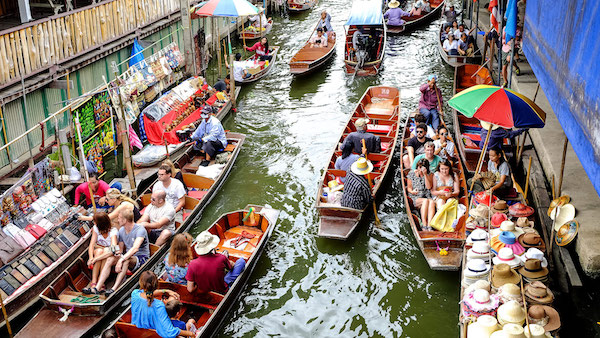
Damnoen Saduak is one of Thailand's best-known floating markets.
The floating market offers an authentic experience, even though it is very touristy.
There are dozens of wooden boats with fresh fruits, vegetables, and flowers.
Chinatown
Chinatown in Bangkok is known as being one of the biggest in the world.
Packed with small stands, food stalls, and shops, Chinatown in Bangkok is an experience which you cannot miss.
Chao Phraya River
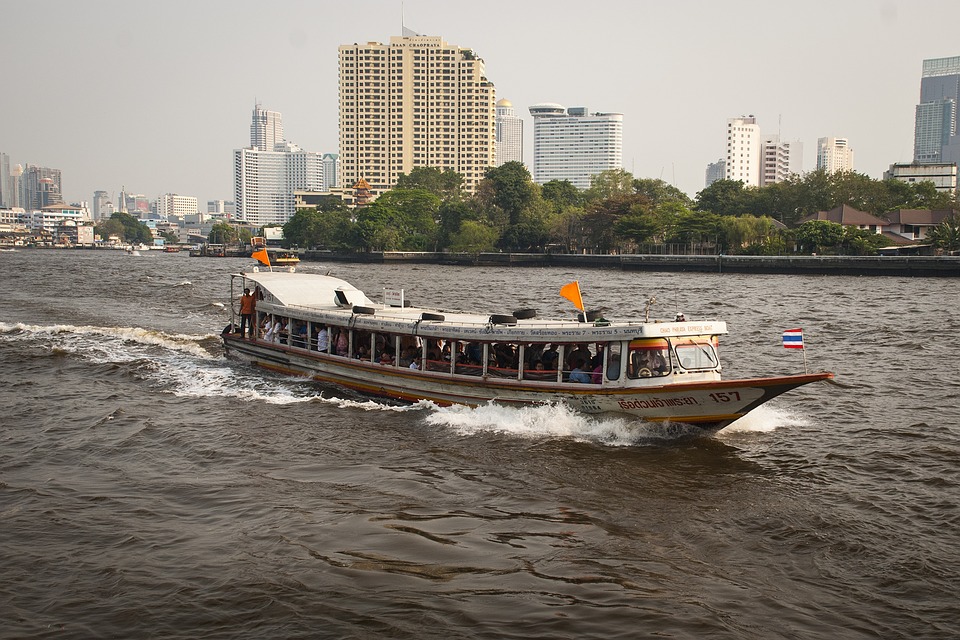
The Chao Phraya River is a great way to explore the city of Bangkok.
Tourist longboats show you beautiful places along the river, and transport ferries can bring you across the river to various locations.
Taking a boat as a way of transportation can be a great opportunity to see the different areas of the city.
Chatuchak Market
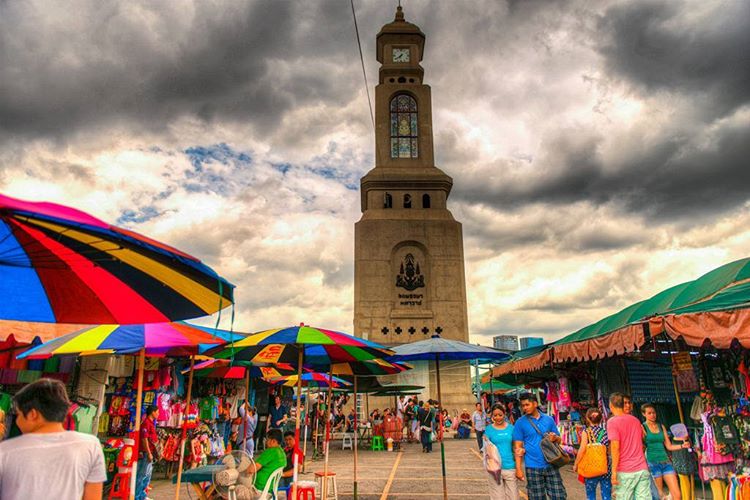
Chatuchak market is one of the most popular markets in Thailand.
Once popular among traders and wholesalers, Chatuchak market has now become a major tourist attraction.
The thousands of stalls on 35 acres of land offer all kinds of products like clothes, furniture, souvenirs, food, and much more.
On weekends it can draw very large crowds.
How do you get around Bangkok?
There are many different types of transportation methods in Bangkok.
For example, the BTS Skytrain, MRT Subway, taxis, motorbike taxis, buses, boats, and of course the famous tuk-tuks.
Below you can find the systems map of the Bangkok Transit System, Metropolitan Rapid Transit, Airport Rail Link, and Bus Rapid Transit.
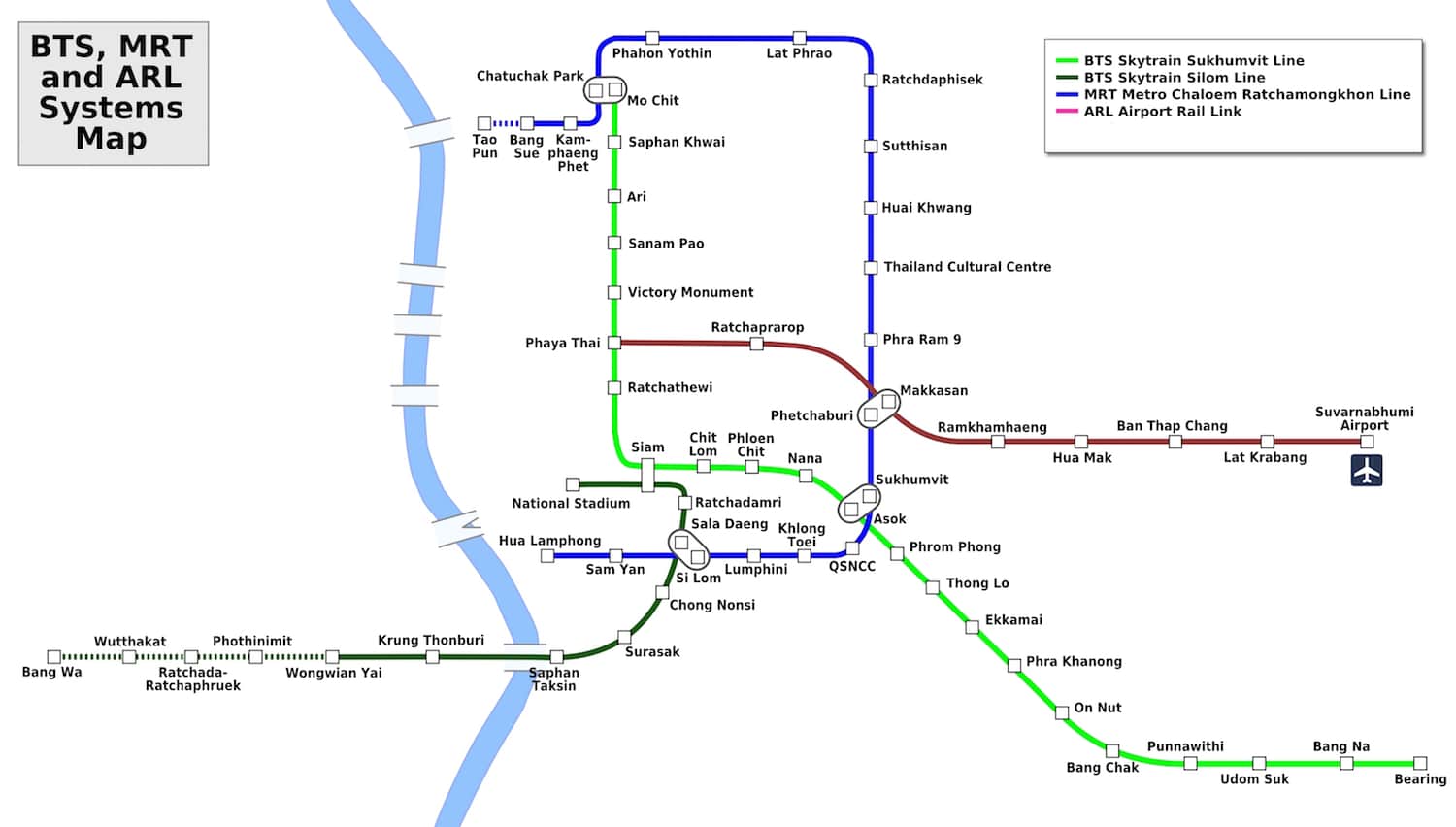
Click to enlarge the map.
Trains usually arrive at each station every few minutes and take you to various destinations throughout the city of Bangkok.
There are several connection points where you are able to get on another transport line.
Tickets are inexpensive and are easily payable by machines at the stations.
The BTS uses its own Rabbit card, which you can top up, while on the MRT you can simply tap a contactless Visa or Mastercard card at the gate.
Traveling by taxi in Bangkok is another very common method of transportation. There are some important things you should know before using taxis in Bangkok.
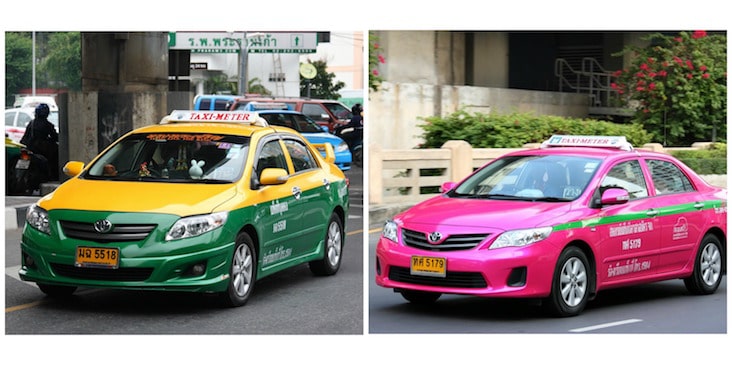
Firstly, taxis in Bangkok are painted in a range of bright colors.
The full colored taxis are rented out by drivers and are not always the most reliable.
The drivers sometimes will not want to drive to your destination, and/or they will not turn on the taxi meter and will try to charge you a high price.
The multi-colored taxis (e.g. yellow/green) are known to have a better reputation, as they are privately owned cars.
Also, try not to pay a taxi driver with anything more than a 100 Baht banknote, as some drivers pretend not to have change.
What and where should you eat in Thailand?
During your stay in Thailand, you will discover that there are many different types of food and unique places to eat.
Unlike many other countries, it's not necessary to visit a traditional restaurant for lunch or dinner.
It is very popular among locals to eat their meals from street food vendors and stalls.
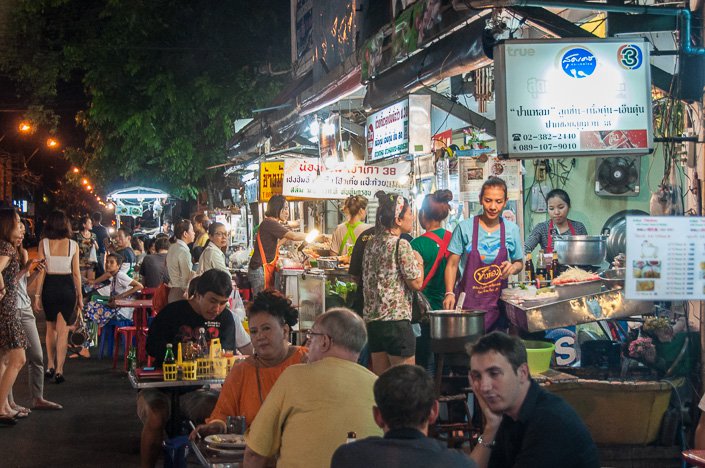
The big advantages of eating street food are that it's very affordable, you receive your order extremely fast, and the meals are prepared in a very homemade fashion, as compared to typical restaurants.
For an average street food dish, expect to pay roughly 50 Thai baht, but prices vary, so check what vendors charge near you.
See our travel and food guides
Do's & Don'ts
The image below sums up the main dos and don'ts. The Culture section further down covers the monarchy and greetings in more detail.
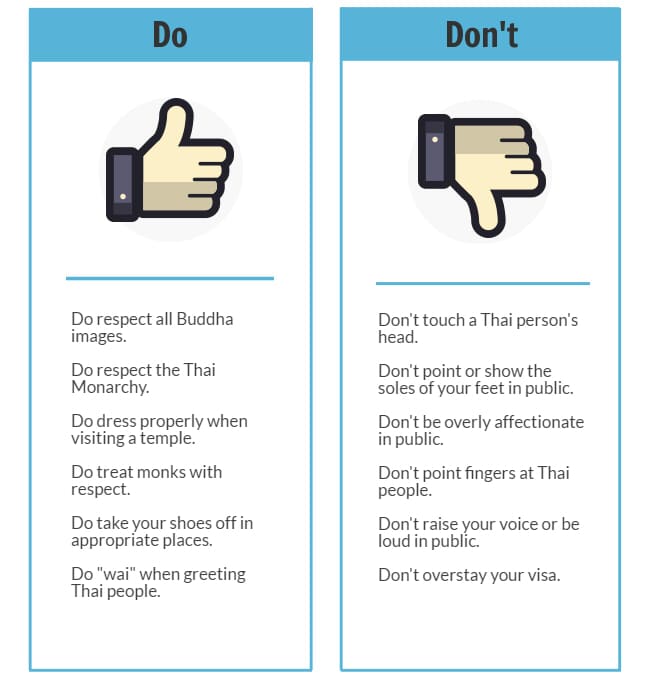
Where are the medical facilities in Bangkok?
It is very important to be aware of the medical facilities around Bangkok, Thailand in case of any illness or emergency you may have.
Ask your host company or your hotel for a hospital near your home and office, and save it in your maps app before you need it.
Which immunizations should you ask your doctor about?
Before coming to Thailand it's ideal to visit your personal doctor for a routine checkup.
Thailand has high-quality medical facilities, but it is wise to arrange health insurance before you travel.
Medical costs in Thailand can become quite expensive without insurance.
Ask your doctor or a travel clinic which vaccines you need for your own situation. For a stay in Bangkok, staying up to date with routine vaccines is usually the main thing. The list below shows vaccines travelers to Southeast Asia often ask about, and some of them, such as Japanese Encephalitis and Rabies, usually only apply if you spend time in rural areas or travel elsewhere in the region:
- Hepatitis A
- Hepatitis B
- Typhoid
- Japanese Encephalitis
- Rabies
- Diphtheria/Tetanus/Polio
What should you know about Thai culture?
The Monarchy
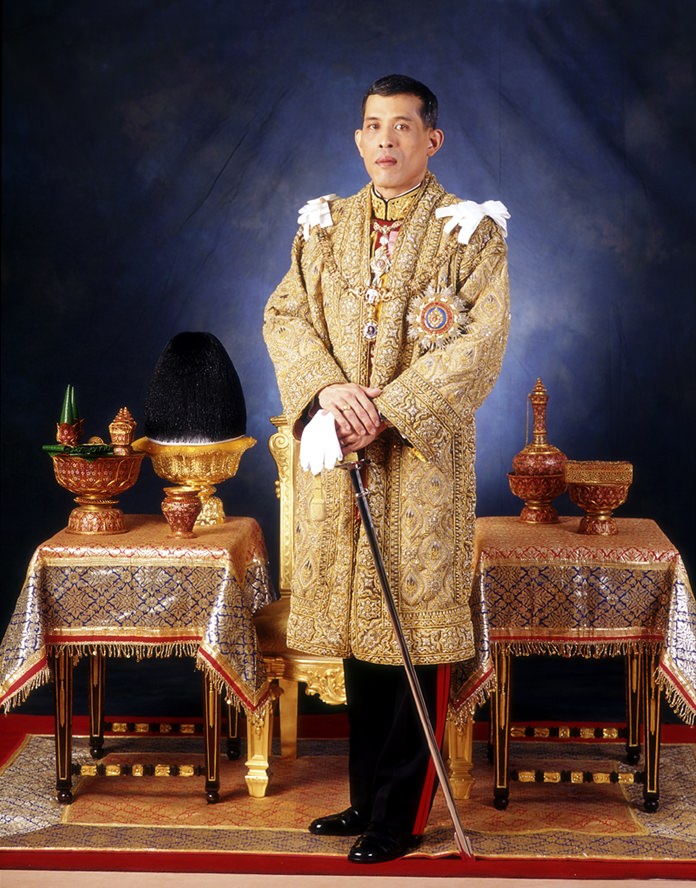
It is very important to be respectful of the Thai Royal Family.
Thai people are extremely respectful and loving toward their King.
Vandalizing, damaging, or destroying images, monuments, or statues of the King or Royal Family in any way can lead to imprisonment.
So it is very important to always show respect to the Monarchy.
Greetings
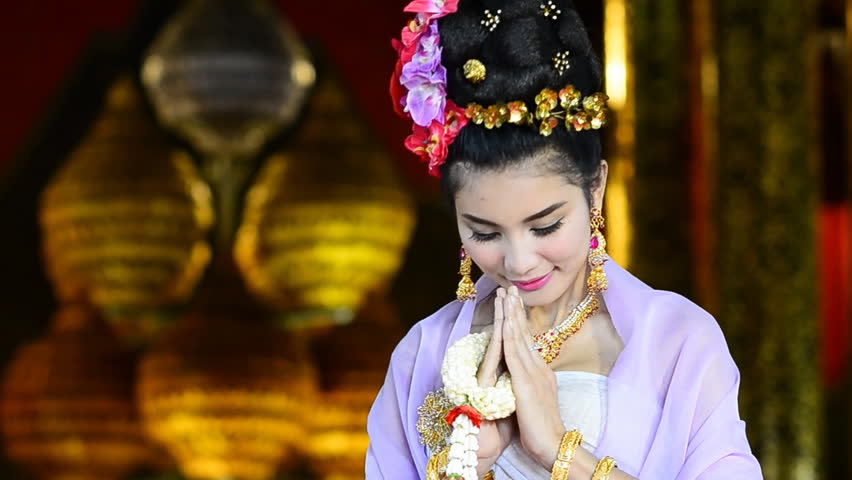
A big part of the Thai culture is about being respectful and polite to others at all times.
One simple way that visitors in Thailand can show respect to Thai people is by learning the traditional hand gesture for greetings and thank you's.
This gesture is called 'wai' and is done by putting your hands together in front of your chest, and slightly bending your head forward.
It is not expected for you to do it, but when someone does a wai to you, you're expected to wai back.
If you're looking to meet new people, here are 12 Tips: How To Make Friends During Your Internship Abroad.
What are some interesting facts about Bangkok?
Bangkok has the world's longest place name, according to Guinness World Records.
Krung Thep (Bangkok) is the shortened version of the full ceremonial name, which has 168 letters when written in English.
The full city name is Krungthepmahanakhon Amonrattanakosin Mahinthara Yutthaya Mahadilok Phop Noppharat Ratchathani Burirom Udom Ratchaniwet Mahasathan Amonphiman Awatansathit Sakkathattiya Witsanukamprasit.
The translation of this name is the city of angels, great city of immortals, magnificent city of the nine gems, seat of the king, city of royal palaces, home of gods incarnate, erected by Visvakarman at Indra's behest.
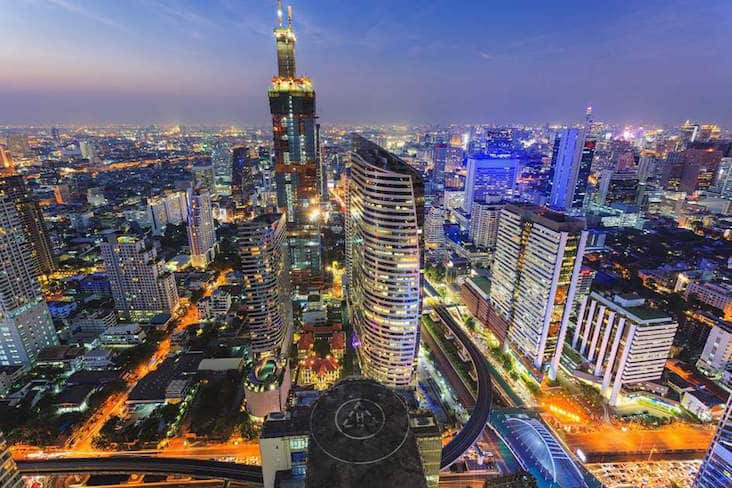
The King's Anthem is played before movies and cultural performances.
Before a movie, play or cultural performance, the King's Anthem is played and everyone must stand out of respect.
Also at train stations, the Thai National Anthem is played twice a day at 8 AM and 6 PM.
Always stand when you hear the anthem. It is a matter of respect and it is not worth the risk of offending anyone.
Enjoy your stay in Thailand!
Asia Internship Program wishes you an enjoyable time in Thailand during your internship.
These tips and recommendations should help make your time in Thailand more enjoyable and stress-free.
If you found this guide useful during your stay in Thailand, share it with your friends who may also be interested in doing an internship in the Land of Smiles.
FAQs
Where should I exchange money in Thailand?
Exchange your money in the city rather than at the airport, because city exchange shops usually give a better rate. Vasu Exchange, Super Rich and SIA Money Exchange are popular choices, and you can find exchange shops at many BTS and MRT stations and in major shopping malls.
How do I get a SIM card in Thailand?
Thailand's main networks are AIS and True, which also runs the dtac brand. Take your passport to a carrier shop or authorized dealer, for example in a major shopping mall, because foreigners must register their SIM in person.
How do I get around Bangkok?
Use the BTS Skytrain, the MRT subway, the Airport Rail Link, buses, boats, taxis, motorbike taxis and tuk-tuks. Trains are inexpensive, run frequently and have stored-value cards, and metered multi-colored taxis tend to be more reliable.
How much does street food cost in Thailand?
An average street food dish is roughly 50 Thai baht, but prices vary by area and vendor. Street food is popular with locals because it is affordable, fast and freshly made.
What should I know about Thai culture before my internship?
Show respect for the Thai Royal Family, greet people with a wai and return a wai when you receive one, and dress properly at temples and the Grand Palace. Use polite endings: ka for women and krub for men.
Still planning your internship? See our Thailand internship page or apply now. Found this guide useful? Share it with friends who want to intern in the Land of Smiles.
Thinking about interning in Asia?
Browse destinations, then apply. It's free to apply, and you only pay a deposit once we accept you.
 Nisha Shahi